Completed
Banana revitalisation
Demonstration farms, Black Sigatoka management, and tissue-culture seedlings with TaiwanICDF support.
Banana revitalisation
Banana farming remains one of the most socially and economically resonant agricultural activities in Saint Vincent and the Grenadines. Even after preferential market arrangements with Europe narrowed and Latin American competitors set a high bar on volume and price, bananas and plantains still structure rural livelihoods, local food supply, and political attention across parties. The Banana Revitalization Project, implemented with TaiwanICDF financing and technical leadership from the Taiwan Technical Mission working alongside the Ministry of Agriculture, tackled a problem farmers could feel in every diseased leaf: low unit output driven in part by Black Sigatoka and by gaps in cultivation practice.
TaiwanICDF records the formal implementation window as 6 May 2019 to 31 December 2022, with a signing date matching the start. The stated objective was clear and measurable: raise unit output on assisted plantations toward 25 tonnes per hectare, the international average used as the project benchmark. Executing agencies were the Taiwan Technical Mission in Saint Vincent and the Grenadines and the Ministry of Agriculture, Forestry, Fisheries, Rural Transformation, Industry and Labour. Earlier public launches in 2018 had already framed Black Sigatoka management from Colonarie to Orange Hill as a pilot priority, with government and press notices describing multi-year investment in fungicides, training, mapping, and on-farm support.
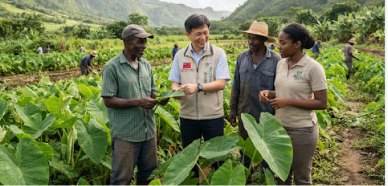
By the end of December 2022, TaiwanICDF’s progress summary listed a concrete package of results rather than abstract intentions. One demonstration farm was established at Orange Hill, and four farmer demonstration fields were set up. Eight observation workshops showcased demonstration-field achievements. Rationalised fertilisation was promoted across 160 hectares. Fungicides and mineral oils for Black Sigatoka control were supplied, with spraying strengthened over 1,620 hectares of banana plantings. Sixteen farmer training sessions were held. Extension officers were trained in disease prediction and investigation, and weekly field surveys fed an epidemic notification system that alerted farmers. An integrated pest management model was introduced. Tissue-culture seedling production reached 43,988 plants.
Those numbers matter because they describe a system, not a single donation day. Demonstration plots make improved practice visible. Extension officers translate laboratory and mission expertise into weekly advice. Tissue-culture seedlings give farmers planting material with a cleaner start. Epidemic notices shorten the lag between field observation and farmer action. Together they address the project’s core diagnosis: unit yields can be improved by technical means even when terrain, wages, and global prices remain difficult.
A closing ceremony in November 2022 marked the end of the implementation phase, with Taiwan’s ambassador and Ministry officials among those acknowledging the work. Permanent Secretary comments recorded in Ministry coverage thanked Taiwan for sustained agricultural support. For the Embassy’s Relations portfolio, the project is filed as completed under the agriculture cooperation sector. It is a public partnership story—technical cooperation and capacity building—distinct from private agribusiness investment marketed on the Trade side of the site.
Readers should treat published TaiwanICDF figures as the authoritative public ledger for this page, while recognising that farm-level income effects continue to depend on weather, labour, and markets after a project closes. Contested or unofficial tallies are not invented here. What can be said with confidence is that the revitalisation effort combined disease management, fertilisation discipline, farmer and extension training, demonstration infrastructure at Orange Hill, and large-scale tissue-culture seedling production under a bilateral technical mission model that Saint Vincent and Taiwan have used across multiple agricultural generations.
The Orange Hill site later reappears in successor programmes for vegetables and young farmers, which is part of the longer arc: banana revitalisation did not stand alone. It reinforced a shared agricultural campus and a habit of joint training that later projects could inherit. That continuity is one reason the Embassy presents projects as a portfolio rather than as disconnected press moments.
Banana revitalisation
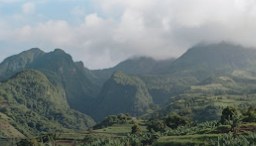
Agricultural landscapes and agronomic partnership themes linked to Taiwan Technical Mission work.